
Hi readers! I hope you are doing well!
This week I was inspired by one of my fashion classes, which is titled Fashion Promotions, to write about the history of some of the fashion industry’s most successful and influential brands. In my fashion promotions class, we are putting on an event on campus that is showcasing our college’s collection of historical clothing that has been donated to our university. I was able to visit this collection recently and I must say that I could spend all day in the collection’s building! The house the historical collection is kept in holds hundreds, if not thousands, of clothing items, including shoes and accessories, that have been preserved for up to more than a hundred years. Seeing the styles and trends from almost every year you could think of from the last 150 years was absolutely incredible. This collection of clothing, shoes, and accessories is a hidden gem at our campus that not many students know about, and that isn’t utilized or displayed as much as it should, so my class decided to throw a live museum to showcase some of our favorite pieces from the building, as well as create our own “inspired by” current looks from the pieces that we loved the most.
I think it is really important to appreciate the history of anything that you love, and for me that is fashion. There is such a rich history to this industry that isn’t really talked about anymore because we are in the age of fast fashion that is constantly moving, changing, and trying to grab our attention. I also think it is important to appreciate the history of fashion because it is always influenced by art, politics, the economy, and movements of the time it was created. By understanding the history of certain fashion pieces and their designers, you might be able to learn more about the status of the events happening around the time of the fashion’s creation. You might also be able to appreciate the technological innovations, stylistic changes, and designer influences that were also created from historical fashion. On this post, I would like to highlight some of those interesting technological innovations and stylistic influences that are now historical to our fashion industry. I will be sharing specific histories of designers and what significant shoe design the created and how that has influenced the future of the fashion industry. With that being said, I hope you enjoy this long post today and learn something new about historic shoe fashion!
To begin, I wanted to start off with the first major shoe designer that influenced many future generations to come. Even though I am a third-year fashion student, I have never learned about this designer and his specific shoe designs, as well as what current events and themes had influenced his shoes. I think this is due to the fact that he was a major designer in the 19th century, and the fact that I have not focused on shoe designers, rather than clothes designers, in my major. Francois Pinet has been named a legend in the history of shoe design.
He was born in France in 1817, when and where fashion and design was really starting to take shape and grow. Shoe manufacturing was part of Francois’ family’s tradition. His father was a shoemaker who taught Francois all the skills he needed to also become a shoemaker. From these skills, he not only created shoes, but became an influential designer that would go on to create luxury footwear for the prominent women of France. In 1854 he founded his footwear company in Paris. Quickly after his company was created, it became famous for his creations of elegant and sophisticated styles. These styles, which were mainly boots and flat shoes, were created for the high society women that would attend grand balls and gala events. His shoe designs were intended to go perfectly with the ornate ball gowns that these women would wear to these high-class events. I learned that it is possible that his shoe designs were intended to be worn specifically with Charles Frederick Vorth ball gowns.
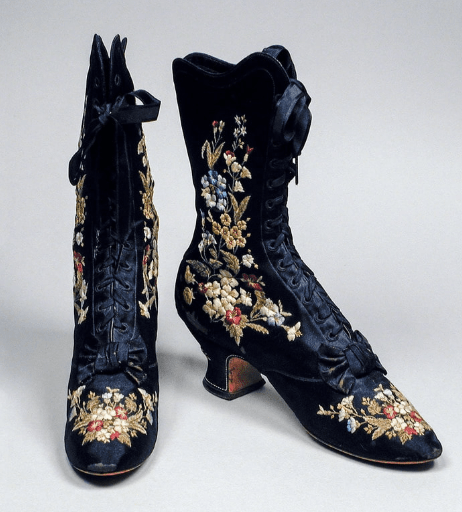
I also learned that Francois’ most famous design was a special promenade boot, which women would wear to match their magnificent dresses during the crinoline era of the 19th century. This is when women would wear large dresses to show off their wealth. Large dresses would be impossible to work or do manual labor in, which was a sign for others that she was not required to do any work. It would also be evident that these women would be unable to work in these promenade boots Francois designed because of their heel. These promenade boots are interesting to look at—and I’m sure at the time they were even more interesting to wear—because they were decorated with ornately designed and colorful floral embroidered patterns. Of course these patterns were a signature work created by Francois, but they were also indicative of the romanticism period of the 19th century. This was a time when women’s dress became increasingly decorative and delicate. The artists of the Romantic period valued how emotion and sentiment was perceived through their works.
It is interesting that Francois uses floral embroidery to make his shoes ornate, because this type of pattern was seen as only appropriate on gowns. He was the first to create this stylistic choice on shoes; and think about how now variations of floral embroidery is on all kinds shoes designs, men’s and especially women’s shoes. The flower embroidery, although it seems insignificant today, was revolutionary for the fashion industry then. He was able to showcase elegance and sophistication in these ornate designs, and that has, and will continue to, inspire other fashion designers to follow.
The next historical fashion designers that I found interesting and wanted to share with you all was Cyrus and James Clark. These brothers founded the brand “Clarks” in 1828, that you may be familiar with because the brand is still manufacturing and selling designs today. They founded their brand in Somerset, England, and that is where the brand’s headquarters are still located to this day. The reason why I wanted to research the origins of their brand, and the influence they have had on the fashion design industry, is because their shoe brand is still successful today and was successful when they created it.
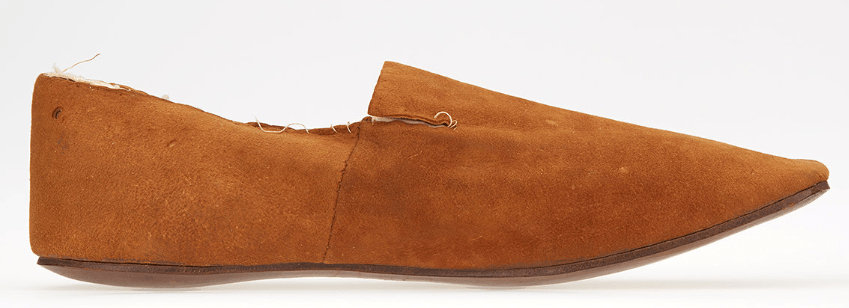
Their business was also a family business. I found their origin story to be interesting because it was not actually founded as a shoe company. Cyrus Clark took over his father-in-law’s business of rug making from sheepskins in 1825. This business was growing steadily, and by 1828, Cyrus needed help from his brother James to continue the rug manufacturing business. Interestingly enough, James found a creative use for the extra sheepskin material that would be left over from the rugs that they would make. He began to make slippers, which were called Brown Petersburgs, from this extra material. Together the now newly shoe designer brothers began to develop their business into a nationally and internationally traded company. They were selling their products in Ireland by the 1820s, Canada by the 1830s, and Australia by the 1850s. This is an extreme accomplishment for a fashion brand in this time period, let alone a shoe brand that was creating very wearable shoes, not ostentatious heels or the like, and selling them all over the world.
I enjoyed learning what the Clarks brand provided for its workers. In the late 1880s and early 1990s, the main factory that produced the brand’s shoes provided benefits for its employees to improve their life outside of just working for the company. The factory had a school, theater, library, swimming pool, playing fields, and low-cost housing for their employees in order to create a well-rounded life for them. I think that this provides evidence of how this brand was different than other fashion brands at the time, and quite honestly, some of today’s fashion brands. Not only was Clark’s winning awards like the Gold Medal at the Great Exhibition in 1851 for their innovation in shoe design, but they were going deeper in improving more beyond the fashion industry.
One of the innovative ideas that the designers of Clarks were able to accomplish and share through their creations that influenced the future of the fashion industry was the idea that ill-fitting shoes could create life-long problems for your feet. With this knowledge, they were able to create a new shoe sizing system based on thousands of analyses of measurements taken from their headquarters’ location. With this information, they were able to produce sizes with four different width ranges to accommodate their consumers. This desire to create something that would improve the lives of their consumer is the reason why their brand is still successful today. They were able to change and improve the science behind the shoe sizing technology that the entire industry would have relied on. Their efforts to improve the well-being for their wearer is the reason this brand and its designers have been so significant in the fashion industry.
The last fashion designer that I wanted to inform you on was J. Sparkes-Hall. He had the interesting occupation of creating shoes, specifically a pair of boots, for Queen Victoria. In 1837, he was tasked with the assignment of creating a pair of boots for her that did not have any shoelaces; this is because her shoelaces had been getting stuck in her stirrups while horseback riding. In order to accomplish this task, Sparkes-Hall created a boot that used vulcanized rubber (created by Charles Goodyear not very long prior) as elastic on the sides of the boot. This made it possible for the wearer, predominately Queen Victoria at first, to slip the boots on and off with ease. These boots became world-famous around the 1850s, which inspired the Chelsea Boot Company to be founded.
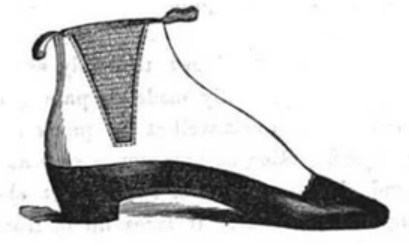
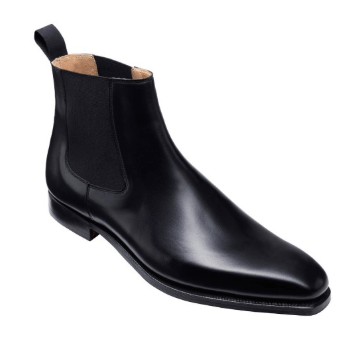
Today, this style of boot is a staple to the shoe industry. Numerous brands have adapted this original design and innovative idea into their own style. By combining Goodyear’s innovation with his own, Sparkes-Hall was able to revolutionize the structural style of a type of shoe that was essential to everyday life.
I hope you enjoyed reading my long post this week! I know I certainly enjoyed researching historical fashion and shoe designers who I had never heard of! Let me know if you had ever heard of these historical designers, and if you did or didn’t, tell me something new that you learned from my writing. I think my major takeaway from writing this post this week was obtaining a larger appreciation for the history of the designs that we see every day, and the ones we don’t see, because these designs have adapted into the fashion that we all know and love now. I thought the best part of this learning process was learning about influential fashion designers who I had never heard of, but then being able to gain an understanding of their influence on current and historical fashion designs once I saw their original designs. I could easily see characteristics of their historical designs in fashions and designers that are popular today and that followed the work they created first. It is so amazing how historical fashion trends swing in and out of style throughout different decades, but it is even more interesting once you see how even older fashion designs have become integral to how we wear clothing and shoes today. There are many elements to these shoes from these historical designers that will never go away because they have completely revolutionized the idea of shoe fashion, the structural components of all the different types of shoes we have today, and the overall look of our shoes. Although it is a growing industry, with new creations coming out every day, I think it is important to understand and appreciate how this ever-growing fashion industry got its start, even if you don’t necessarily find fashion interesting, or as appealing as I do. I think writing this article about historical designers and their influence on the fashion industry has really made me appreciate the overall history of the fashion industry. I am grateful that I was able to visit my university’s historical collection of clothing, shoes, and accessories, but it was the main reason I was so interested in studying historical fashion designers this week.
With all of that being said, thank you so much for reading my article, and I hope you have a fun and educational time!
Until next time,
Happy reading!
Anna
 Sole Mate Shoes